Abstract
Employing quantum mechanical resources in computing and networking opens the door to new computation and communication models and potential disruptive advantages over classical counterparts. However, quantifying and realizing such advantages face extensive scientific and engineering challenges. Investments by the Department of Energy (DOE) have driven progress toward addressing such challenges. Quantum algorithms have been recently developed, in some cases offering asymptotic exponential advantages in speed or accuracy, for fundamental scientific problems such as simulating physical systems, solving systems of linear equations, or solving differential equations. Empirical demonstrations on nascent quantum hardware suggest better performance than classical analogs on specialized computational tasks favorable to the quantum computing systems. However, demonstration of an end-to-end, substantial and rigorously quantifiable quantum performance advantage over classical analogs remains a grand challenge, especially for problems of practical value. The definition of requirements for quantum technologies to exhibit scalable, rigorous, and transformative performance advantages for practical applications also remains an outstanding open question, namely, what will be required to ultimately demonstrate practical quantum advantage?
Agency Report
- Original Listing at OSTI
- Original PDF at OSTI
- Cached PDF local copy
Selected Images
Selected Extracts
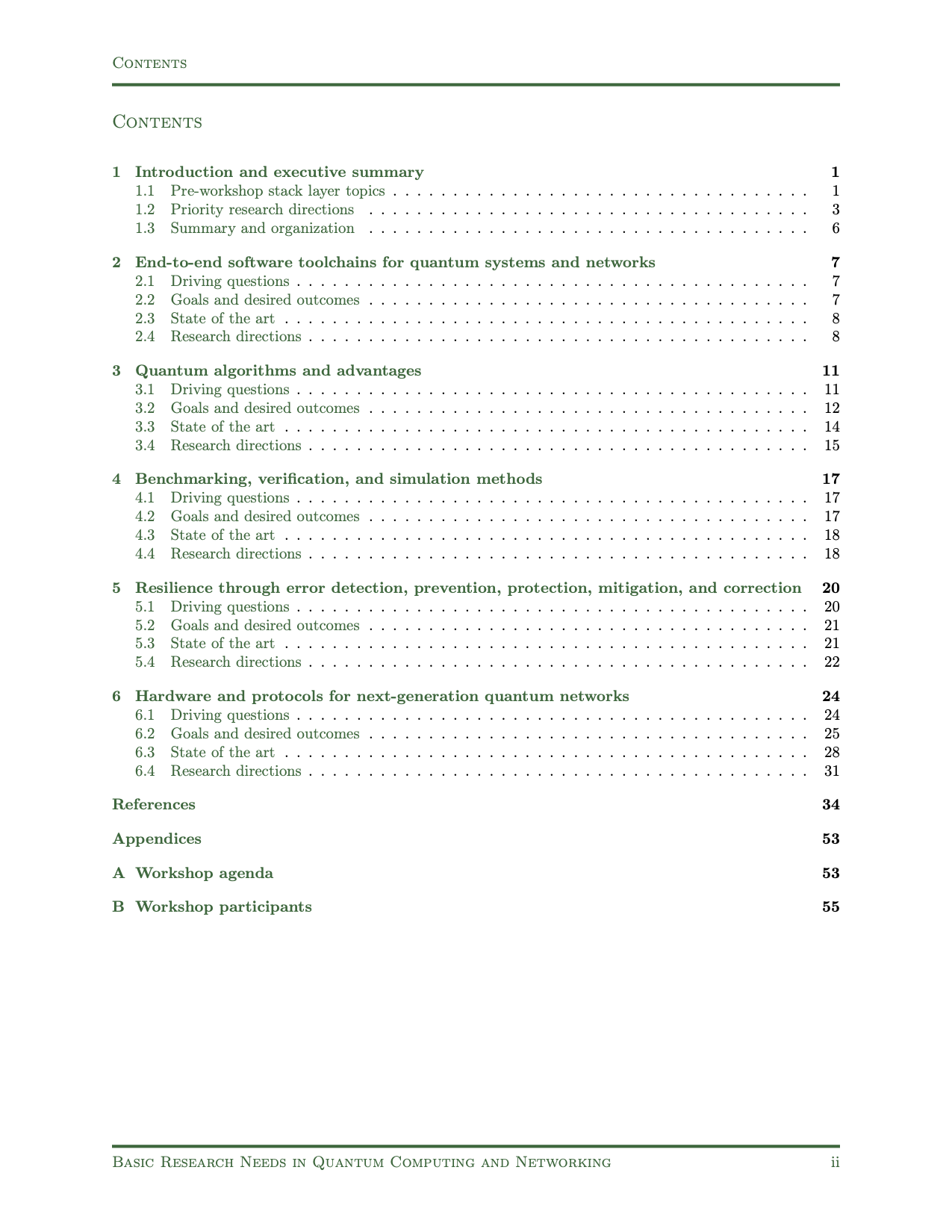
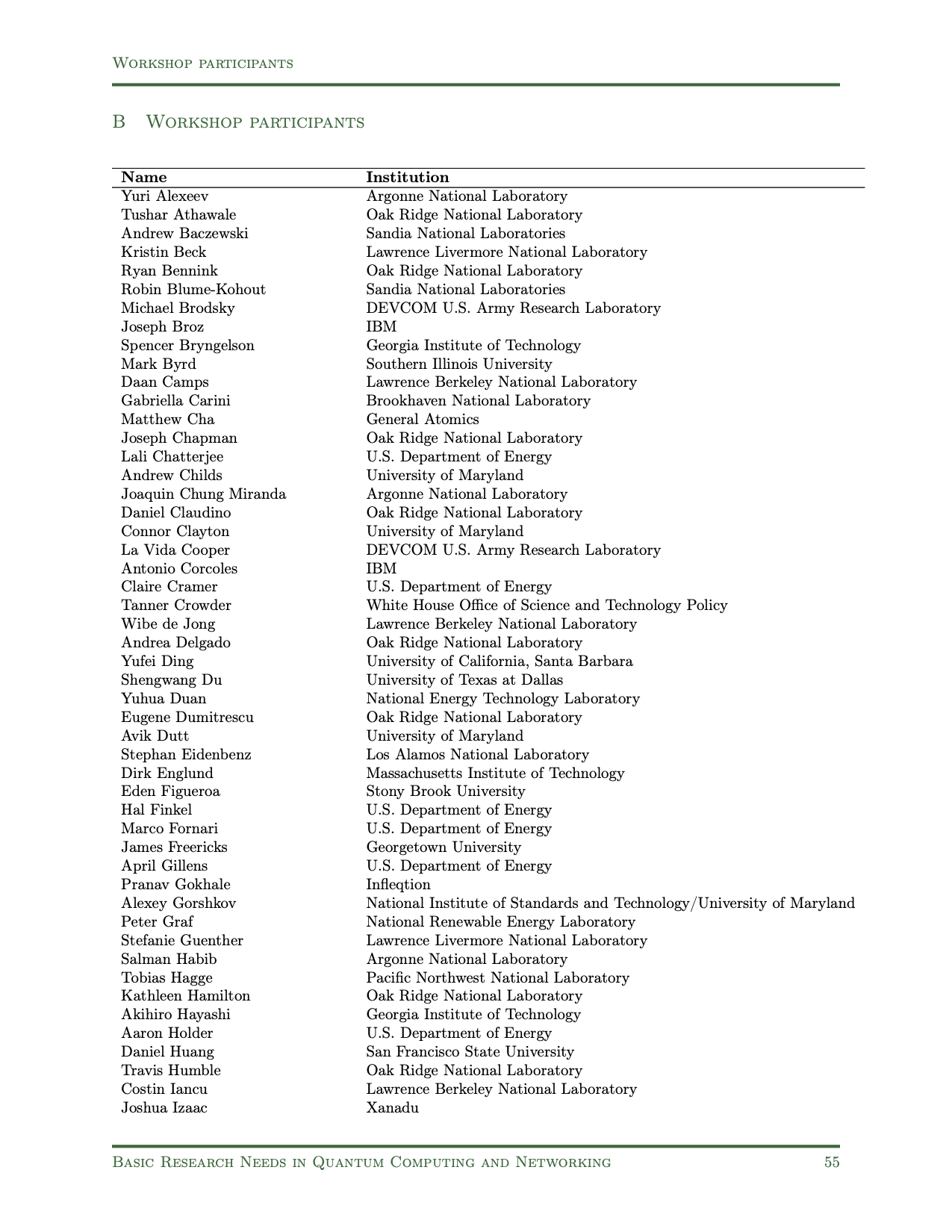
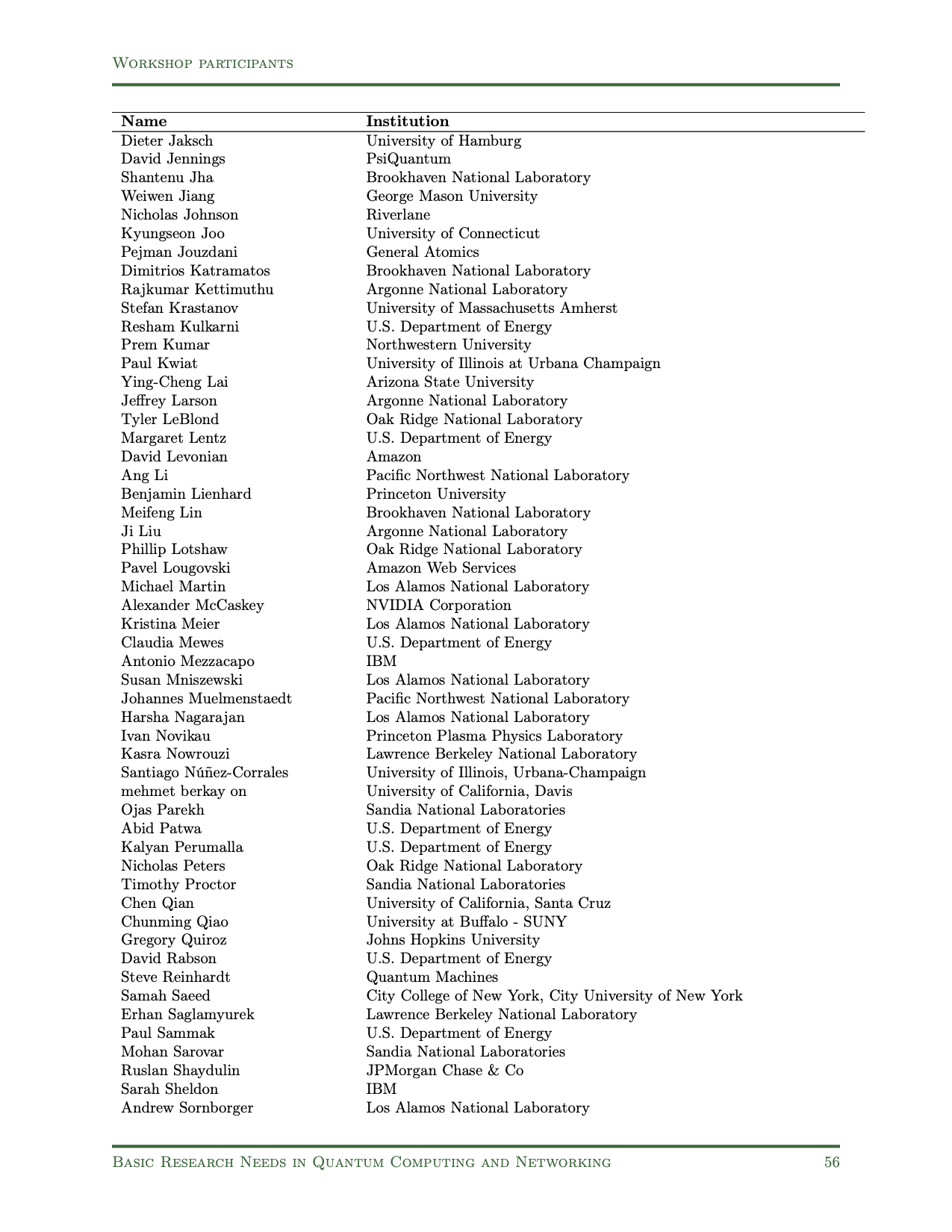
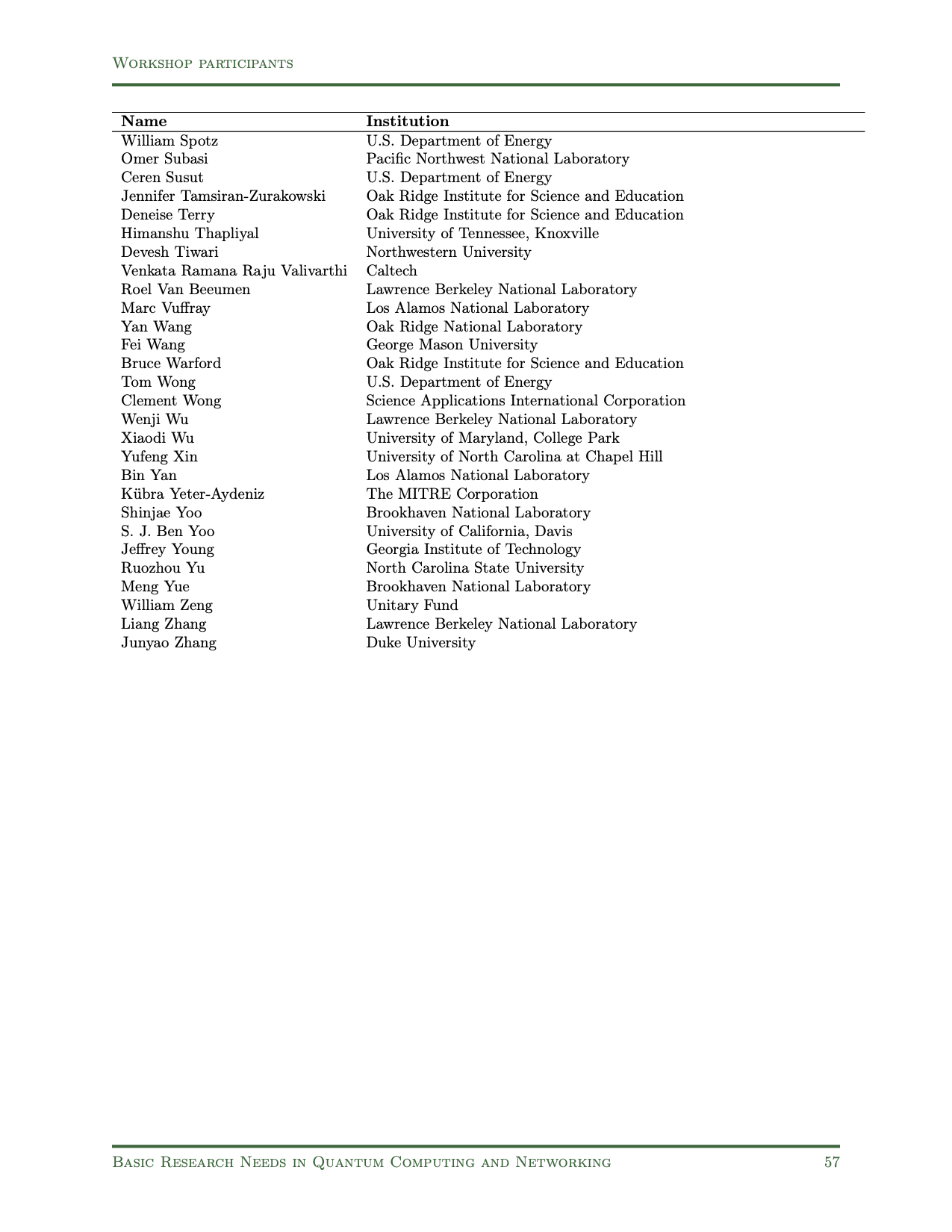
In July 2023, DOE’s Advanced Scientific Computing Research (ASCR) program in the Office of Science (SC)convened the Workshop on Basic Research Needs in Quantum Computing and Networking, where major opportunities and challenges were discussed and identified. Before the workshop, a pre-workshop report was prepared to seed potential research themes, and community input was solicited in the form of brief position papers. These formed the basis of panel and discussion sessions at the workshop. This report summarizes the findings of the workshop.
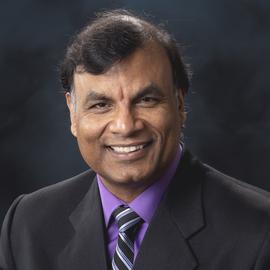
Kalyan Perumalla
Kalyan Perumalla is a computer scientist focused on research in supercomputing, quantum computing, and artificial intelligence, as research staff member, faculty, and program manager with the U.S. government, national labs, and universities. As a Federal Program Manager in Advanced Scientific Computing Research at the U.S. Dept. of Energy, Office of Science, He managed a $100-million R&D portfolio covering AI, HPC, Quantum, SciDAC, and Basic Computer Science. In his 25-year R&D leadership experience, he previously led advanced R&D as Distinguished Research Staff Member at the Oak Ridge National Laboratory (ORNL) developing scalable software and applications on the world’s largest supercomputers for 17 years, including as a line manager and a founding group leader. He has held senior faculty and adjunct appointments at UTK, GT, and UNL, and was an IAS Fellow at Durham University.